A re-post from quite some time ago – my mother and brother 💞 have both passed away since the writing of this true story.
__________________________
It is the Easter long weekend and my thoughts are drifting to things religious. My Mum is a crazy catholic, there is no doubt about it. She is more traditional than the Pope and right up there with Mother Theresa when it comes to devotion and dedication to God. Her rosary beads, scapula and gold crucifix on a chain never leave her person. She worries constantly about her four children who have strayed somewhat from the faith. But that’s another story.
Today I am going down memory lane to a time when I accompanied my mother to the middle of a war zone in the name of God. It was May 1995 and I was single, in my twenties and pretty much a zombie depressive with violent tendencies. My Mum decides that she must go to Bosnia-Herzegovina on a pilgrimage to the town of Međugorje. Problem was the Bosnian war was raging and hundreds of thousands of people had been killed in the conflict.
Why would anyone want to go to Bosnia during the war? Mum explains that Međugorje is a Marion site, a place of miracles similar to the holy site of Lourdes where Our Lady appeared to small children. A place where water from springs has miraculous qualities and can heal all manner of ills. Yeah right I thought, blah, blah, blah.
She must travel to this small village in Bosnia-Herzegovina to receive blessings from Our Lady who appears daily to young visionaries. “Yeah, but why do you have to go this year while the war is full on? ” I asked horrified.
She responds with “Nothing will happen to me or the people of Međugorje as God is protecting the town”.
Yep, I told you she was crazy.
Well, I just had to go with Mum to make sure she didn’t get blown up, and if she did I wanted to get blown up with her. After a very long journey, including two plane flights and a 3 hour bus trip on winding mountainous roads, we arrived at Međugorje, a small nondescript town on flat farming country surrounded by rocky snow covered mountains. The largest building in the town was a cathedral. The only sign of the conflict was the presence of NATO soldiers in the cafes, large rifles at their sides, and the odd tank roaming around town.
The pilgrimage was only for one week but that was long enough. Mum said the rosary about 5 times a day and went to mass twice a day. There was an obligatory trek up neighboring Mt Crucifix to worship at the foot of a giant white cement cross. I had to literally push Mum up the narrow paths to get there and I still don’t know how she did it. I must admit the views from the top of the mountain were to die for, if you’d pardon the pun. The people were all lovely and I did get caught up in the peace and energy of the place.
However, the war was never far from anyone’s thoughts. At every mass the priests would report on the casualties from the war. One day 3 priests were killed in a nearby village and a town in central Bosnia was destroyed with a reported 5,000 dead.
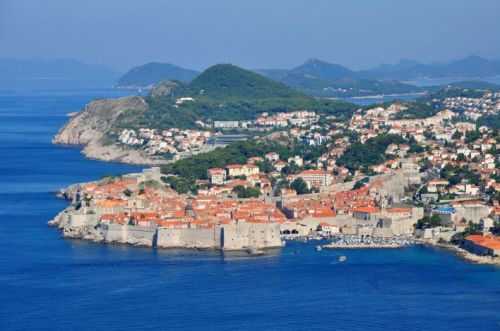
On our second last day a group of pilgrims, including Mum and I, traveled over the border by bus to nearby Croatia to visit one of the most beautiful cities in the world, Dubrovnik.
The day trip was an eye-opener. We passed through village after village decimated by the war. Lovely old buildings and churches blown to pieces by bombs. There was a bridge that had been totally destroyed. There was a forest near Dubrovnik where nearly every tree had been decapitated by gunfire. We saw a number of tanks travelling the same roads as our bus.
We arrived at Dubrovnik and I immediately fell in love with this ancient walled city with narrow cobbled streets on the crystal waters of the Adriatic Sea. Dubrovnik is one of the world’s great tourist destinations but it was completely empty of tourists, apart from the crazy busload of Catholics. I felt my heart wrench for the locals whose main source of income was money from tourists.
Mum and I walked through the winding streets looking into exquisite gift shops and stopping at a restaurant for a seafood lunch. I was surprised that these places were open but the locals were desperate for trade. Dubrovnik had been this way for some time. One good thing was that the great wall surrounding the city had protected the inhabitants from bombs and sniper fire.
Two days later we returned safely to Brisbane, Australia, much to the relief of Dad. We missed a connecting flight at Bangkok because of a search by customs for drug smugglers and arrived a few hours late. Dad was in a bit of a state, convinced that something had happened to us in Bosnia.
The war in Bosnia ended a few months later.
Mum has been back to Međugorje a couple of times since than and would like to go again but is quite elderly and frail. She also feels, as mothers do, that she has to look after her son, my brother, who has acquired brain-injury, and can’t leave him for any length of time. The irony is that I think the main reason she goes to this little town of miracles is to pray for a miracle for him.
Happy and safe Easter everyone.
_________________________







 Gabe Feathers McGee
You must be logged in to post a comment.